- The Incline
- Posts
- The Public Trust
The Public Trust
A check-in from The Incline and a reflection on someone Hamilton recently lost.

Chris Erl
December 30, 2025
…but first, a note from The Incline.
Where has the time gone? No, seriously, where did it go? I feel like I blinked too hard in July and suddenly we’re a stone’s throw from 2026.
After the whole unpleasantness with the City wrapped up in late October, I had a rather ambitious goal to start publishing more. That goal was reprioritized thanks to a painfully busy semester of teaching and research. Have to pay the bills somehow! All that meant that I was only able to get two editions out over the past few months. Sure, I spent three weeks researching my last edition on the Salvation Army in Hamilton, but my newsletter output has dropped noticeably since August.
That means I’ve been missing some big developments that will impact Hamilton, our province, and the country as a whole as we drag ourselves - exhausted, disillusioned, but still clawing our way ever forward - into 2026.
***
On Tuesday, December 16, Hamilton Centre’s Liberal MP, Aslam Rana, was one of six MPs briefly held at the border of the West Bank by Israeli authorities before being denied entry to the occupied territory. Hard to say if this will ingratiate the fortuitous parliamentarian with the deeply passionate political community of folks in Hamilton Centre for whom the situation in Palestine is a top concern, but it did manage to get him some press that backbenchers are rarely afforded.
I had a new piece run in The Spec about Doug Ford’s ongoing assault on Ontario’s increasingly fragile democracy, namely the province’s outdated electoral districts, the plan to amalgamate our conservation authorities, and the looming decision on whether to abolish the office of school trustee. Here’s a gift link if you’d like to check that out.
Many Hamiltonians found themselves on the hunt for new third spaces after democracy* on Locke announced their closure just weeks after their employees successfully unionized for better working conditions. Their fight for, as was reported by the CBC, changes to “health and safety, scheduling and tipping” at the café was evidently too much for the owner, who decided to close the west Hamilton institution rather than negotiate fairly with workers who were exercising their constitutional right to join a union. Adding insult to injury, the owner closed up shop even earlier than previously announced, putting the café’s workers out of a job right before Christmas. Needless to say, the other businesses owned by the same individual - Donut Monster, Paisley Coffeehouse, and the Mulberry Coffeehouse - will not be getting my business until the ownership changes and/or each business is unionized. Hamiltonians stepped up, though, and raised over $23,000 (to date) for the employees who were laid off through a GoFundMe campaign (which is still active here).
And then, of course, there’s the fact that December has undoubtedly been Mayor Andrea Horwath’s mensis horribilis.
***
The high point for Her Worship came on Wednesday, December 10, when the province announced it would be granting Horwath’s request for a Ministerial Zoning Order (MZO) for the big ol’ vacant three hectare expanse that once was and shall again be Jamesville. The much-anticipated redevelopment of the site had been in planning purgatory for years after CN Rail launched an appeal to try and stop new homes from being built there. The rail company’s worry was that noise, vibration, and odors from their nearby shunting yards would lead residents to complain and possibly sue to stop CN’s operations, so their appeal was a preemptive strike designed to cover their bases. The MZO terminates that appeal and makes it far more likely that redevelopment will proceed imminently.
The public comments collected before the MZO was issued were released by the province and ended up being great for the mayor, with many directly praising Horwath for her advocacy on this file.
It was all downhill from there. The same day, council voted to “delay” the implementation of the much-needed stormwater fee that was set to go into effect next summer. A rebellion by suburban and conservative urban councillors pushed the fee start date to January 1, 2027 - meaning that A) the fee will now be much higher than anticipated when it is implemented, and B) a new council - which may be much, much, much more right-wing - might have a chance to terminate it before it even begins. A couple more “Sewergate” events is a small price to pay if it means “standing up for taxpayers”, right? That minor legislative loss was one more example of how the mayor is seeming less-and-less like a trustworthy legislative captain for the Good Ship Hamilton.
The very next day came the sad news that a child had been struck and killed by an HSR bus on Wilson Street, marking the fourth pedestrian fatality on Hamilton’s streets in the span of a month. Blaming the mayor for that tragedy would be exceptionally crass, even for the kinds of embittered malcontents who scurry around in the comments sections of The Spectator (comments were mercifully turned off for most of the stories about this tragedy) and on social media. Advocates have been calling for greater road safety for years, and the sheer number of fatalities on city streets as of late serves to undermine the collective confidence in our municipality's ability to keep all Hamiltonians safe whilst using active transportation, taking transit, and driving.
That very same day, local reporter Joey Coleman dropped a story that he had been teasing on Bluesky for a while. At the beginning of the month, a bitter dispute between Horwath and her ex-partner over the crumbling home owned by the mayor in the Landsdale neighbourhood became extremely public. Coleman’s reporting sparked interest from the city’s legacy media, who have picked up the baton and run with it.
The story is complicated, but the basics are this: the mayor had an engineer assess her property → the property was deemed unsafe → the city issued an emergency demolition permit → a judge invalidated that permit because the city’s building inspectors were denied access to the property by the tenant and could not verify the engineer’s report → the judge encouraged the city to “reach a mutually agreeable resolution to the dispute” → a new emergency order for immediate repairs was issued → the tenant (Horwath’s ex-partner) still refuses to leave → work got underway to ensure the home doesn’t collapse → the tenant continues to interfere with the work, leading to more court appearances and more media focus on this story.
This whole story feels very personal and sad, but the optics of it are really bad. There’s the fact that the first order was invalidated, which might give some the impression proper procedure wasn’t followed because this is the mayor’s property (even if that isn’t the case). There’s the fact that the mayor owns a dilapidated rental property while the city still endures a generation-defining housing crisis, leading some on social media to throw out the word “slumlord” as a descriptor (not the kind of thing someone who spent years leading a social democratic party would want being used to define them). And there’s the fact that Horwath has consistently declined to comment on this issue, meaning important context is missing and other, less flattering narratives, have come to fill the void.
Horwath isn’t called the “Steeltown Scrapper” for nothing, though. In the last Saturday Spec of the year, the mayor unofficially launched her re-election campaign with an op-ed oozing with optimism. “Hamilton is surging forward,” she writes, saying “There is a powerful momentum in our city, driven by the resilience, creativity and grit of our community.” She positions herself at the vanguard of the city’s progress, making note of advancements in business, construction, and the arts. She reminds Hamiltonians of the MZO, takes time to reflect on the number of new affordable housing projects in the city, her commitment to public safety, her advocacy in the face of US tariffs, her work with the port authority, investments in roads and seniors housing and city hall modernization.1
It’s a strong piece that is meant to dissuade opponents and remind the city’s assorted political machines that Horwath is not accustomed to losing elections. And, frankly, she’s got the most runway right now. Rumour has it that local developers are securing donation pledges for a right-wing candidate who was, up until recently, a Liberal MP for the area, but there haven’t been any definitive announcements from that camp. There have been a few rumblings that Ward 14 councillor Mike Spadafora was considering a run, but I’d say that’s unlikely in 2026 (if the political map is favourable, it is possible in 2030). The silence from perceived front-runner Keanin Loomis is leaving many to speculate that he is unwilling to leave his role at the Canadian Institute of Steel Construction in light of how tariffs are impacting the industry and the fact that serving as mayor might offer someone of his talents less of a chance to make meaningful change than he could in his current role.
While December may have been Horwath’s mensis horribilis, 2026 might end up being her tempus vincere.
Veni vidi Oskee frickin’ vici, if you will.
***
So, yeah, there’s been a lot happening as of late. And, as much as I’d love to write about it all, life keeps getting in the way. Since this newsletter is a passion project that nets me about $20 a month in tips (which are always appreciated and can be made through my Ko-Fi.com page), it means that other work sometimes takes priority.
My goal in 2026 is to be slightly more consistent with publishing, but there are some big projects I have on my radar. I’d love to get at least two editions out every month (maybe moving to Mondays or Tuesdays for publishing instead of Thursdays or Fridays? TBD on that…), so I’m putting my goal schedule out into the universe.
As always, I’m so incredibly grateful to have you as a reader. A strong, healthy, vibrant democracy requires us all to share ideas, know more about our past, and dig into current events. Knowing we’re all in this together helps keep me going.
With that, please enjoy this reflection on someone our community lost very recently.
The Public Trust

Photo by Kimberly Farmer on Unsplash - Edited by author
In February of 1996, a piece of speculative fiction ran in the Hamilton Spectator. An aspirational piece, it imagined the city thirty years on, conjuring a hopeful image of a world now just hours away.
“In the year 2026, Hamilton is acknowledged as the best place to send your child to school in Ontario,” the piece begins. “Children go to vibrant schools in safe neighbourhoods, where the community strongly supports the education they are receiving. The whole child is nurtured.”
It outlines how this fantastical world of the future was created: mentorship programs connected underprivileged youth with nature and literacy programs, a municipal Children’s Council was established to focus on youth issues, a new educational coordinating committee was set up to link local businesses with public school graduates, elected school councils operated in every school community, McMaster University’s researchers study Hamilton’s schools extensively to provide insight on how to adapt teaching methods, and the Public and Catholic boards have been merged with the promise that religious instruction for all faiths could be offered to those who seek it.2
The piece was part of the paper’s “Looking Towards Hamilton’s Next 150 Years” series in honour of the city’s sesquicentennial (150 year anniversary). Rather than speculate on what education would be like in 2146, the author opted for a more realistic and achievable thought experiment. That made ample sense, considering they were already working on the front lines of education in Hamilton, and had been a fierce advocate to public schools for decades at that point.
Many of the speculated changes have not come to pass, unfortunately. But the enthusiasm of the author was reflective of her passion for education and her commitment to this community. It’s all the more sad, then, that the person who penned that optimistic piece - former public school trustee Judith Bishop - will not be able to see the Hamilton of 2026 she once encouraged us all to imagine.
So as we approach that optimistic year - a year in which the office of trustee might be abolished altogether - please enjoy a reflection on a person whose commitment to Hamilton could not be understated.
At the start of the 2010’s, there was an atmosphere of tension in the city. Demographics were changing, decades of sprawl-oriented development had changed the character of the city, and the provincial response to the Great Recession meant that, among other things, education funding just wasn’t what it used to be.
In early 2010, the Hamilton-Wentworth District School Board (HWDSB) announced they would be striking Pupil Accommodation Review Committees for the city’s 18 public high schools. These committees - known colloquially by their acronym “ARCs” - were being established in accordance with new provincial guidelines around how schools would be funded.
The funding regime for public schools in Ontario underwent a massive change during Mike Harris’ tumultuous seven years in power. Early in 1997, the PC government’s Common Sense Revolution was in full swing, with Harris using his legislative supermajority to entirely remake the province to align with his dream of a neoliberal utopia. On January 13, 1997, the province announced legislation that took all taxation power away from local school boards, merged them into new amalgamated “district school boards”, and gave themselves power to dole out education funds as they saw fit. That latter change resulted in hundreds of millions of dollars being cut from public education and thousands of front-line education workers losing their jobs. There were large teacher’s strikes, but they failed to shake the unflappable Tories, whose goals for undermining public education were realized beyond their wildest dreams.3
After forming government in 2003, the Ontario Liberals made few changes to education funding, carrying on with Harris’ legacy and placing the burden of difficult decisions on the backs of school boards which still had no taxation power. A special fund created in 2004 to allow schools to access private funding for repairs barely scratched the surface, creating a timebomb for local school boards.4
In Hamilton, pressure had been building for some time. From 2002 to 2003, 14 schools were closed during a period in which the HWDSB was under provincial supervision. In 2002, the province replaced all 11 trustees with “corporate renewal consultant” Jim Murray due to the board’s passing a budget that included a $16 million deficit. At the time, then-MPP Dominic Agostino told The Spec that Murray’s job was to do the “dirty work” for the provincial government.5 Murray redrew school catchment areas, closed schools, and trimmed the board’s spending in line with provincial priorities.
Even with that reorganization, pressure was still mounting. The provincial funding formula just wasn’t working, but the government’s response was to force boards to close schools, rather than undo the damage of the Harris years.
In early 2010, ARCs were struck for area high schools. And the HWDSB was blunt when letting residents know about the intent of the ARCs - they were consultative bodies, not deliberative ones. “It’s ultimately the decision of the trustees, based on the work of the committee,” Dundas trustee and HWDSB chair Jessica Brennan told The Spec. Later in the process, the board’s new chair, Tim Simmons, told the local paper that “We have 113 schools and if you look in plain numbers, we have enough students for 80 to 85 schools.”6
The 2010 trustee election came and went, two new faces joined a board of seasoned veterans, and the ARC process chugged along. Shortly thereafter, the board decided to close the downtown Education Centre - a mid-century gem of a building that might have been the only decent thing to come from Hamilton’s disastrous experiments with urban renewal. The public was outraged and it seemed as though our elected trustees were actively ignoring the wishes of the community.
Then came the elementary school ARCs.
One of the elementary ARCs focused on what was called the “Dalewood” area. In reality, this meant west Hamilton’s Westdale and Ainslie Wood neighbourhoods. The two communities, which had already lost Binkley Elementary School in 1979 and Princess Elizabeth Elementary School in 1983, looked like they might lose another.7
The ARC came up with innovative solutions on how to keep the three remaining schools in the neighbourhood - Prince Philip, Dalewood, and George R. Allan - open in spite of decades of disinvestment. The committee did impressive work, including drafting plans to reclassify sections of buildings to align with provincial funding formulas and bringing to light the fact that Prince Philip in Ainslie Wood had received $120,000 in capital repair funding since 2000 while George R. Allan in Westdale had received $1.4 million - over 11 times as much.
In the end, the ARC recommended all three schools remain open, as their estimates found that closing one would only net $350,000 in savings. Beyond the monetary figures, parents worried that merging the school communities would lead to overcrowding and Ainslie Wood residents feared the loss of a community hub in the neighbourhood.
The ARC’s report was in contrast to the staff-proposed option, which recommended closing Prince Philip and sending its students to George R. Allan. This, the board claimed, would result in savings from not having to invest in capital repairs for Prince Philip.8
One last meeting was held on March 20, 2012 to discuss the fate of Prince Philip. It was standing room only in the condemned downtown Education Centre. A 1000-signature petition to keep Prince Philip open was submitted to trustees. A teacher told the board “Your vote to close Prince Philip school will obliterate one highly effective learning environment and negatively impact [George R. Allan].” The crowd begged trustees to keep their school open.9
On April 30, 2012, the trustees of the HWDSB met to decide what to do. In the end, a motion was brought to the floor to adopt the staff recommendation, closing Prince Philip and reducing the number of elementary schools in Westdale and Ainslie Wood to just two. It passed 6 to 5.
The motion was moved by Wards 1 and 2 trustee Judith Bishop.
***
This was the backdrop for my first, and to-date, only, run for public office.
I was an ambitious young politico, fresh off my student politics days and diving headlong into graduate school. But I wanted to put my education into practice, so I followed the news about the ARCs, met with concerned residents in the community, and, one year out from the 2014 municipal election, announced that I would be running for school board trustee. “We need an ‘activist’ school board, one that helps make change in Hamilton,” I wrote in a blog post announcing my candidacy. “A progressive, forward thinking school board can be part of the change in this city, not part of the problem.”
I never really thought of myself as running “against” Trustee Bishop. I had wanted to provide the people of Wards 1 and 2 with an alternative that could blend urban planning and school board issues while providing a fresh, new perspective.
Well, realistically, I had wanted to provide any alternative, as HWDSB voters in both wards had not cast a ballot for trustee since 2000 when Bishop beat a single opponent with 71% of the vote. For the next 14 years, Bishop had served without any person in the community stepping up to offer themselves as an alternative, returning to the board by acclamation three times.
A part of me was relived when, in mid-July of 2014, Bishop announced she would not seek re-election.10 Bishop had been a dedicated public servant and a champion for children in the community for decades. But, by the summer before the 2014 municipal election, myself and three other people in the community had registered to run for the school board (one would later drop out after moving out of the city and two more would register in the last few days before nominations closed).
While I believed the voters in Wards 1 and 2 deserved a choice, I did not necessarily think Bishop herself shouldered all the blame for what happened during the Dalewood ARC. She, like every trustee, was forced to do what they could with the limited powers afforded them. The province stripped trustees of their powers and assigned them the unpleasant task of fundamentally changing the structure of communities. That’s why I wanted to bring my understanding of urban planning to the table. That’s why I wanted to be an “activist” trustee. That’s why I wanted to offer my voice to the voters of Wards 1 and 2.
I wrote in my campaign announcement: “I know and respect some of the trustees on the board and will be running as a progressive candidate, not simply an anti-establishment candidate…It’s time for an honest, constructive conversation. That’s what elections are for.”
Trustee Bishop knew that better than most. Her service and dedication to the community stretched over decades, as she first took office before I was even born. And, while the drama of the Dalewood ARC served as one of the final chapters in her long career of public service, there was so much more to her story than those chaotic few years before the 2014 election.
***
Judith Bishop’s life was, above all else, dedicated to social justice and the welfare of children.
Bishop was born in Yorkshire in 1942. Her parents quickly sent her off to boarding school, which she followed with undergraduate studies at Nottingham University. After working with an exchange program during her student days, she connected with young Africans fighting for justice, travelling to Zimbabwe immediately following her studies. For two years, she worked on Oxfam-led daycare, nutrition, and literacy projects. In 1965, she met a young teacher, Alan, working at a local school and they soon married, sharing a passion for justice and education. From there, they moved to Cape Town where they both taught at the local university. But their focus on equality and their political views resulted in the couple being expelled from apartheid South Africa by the nationalist government. After their expulsion, Alan enrolled in Oxford and earned a PhD in English. In 1972, he landed a job as a professor at McMaster University and brought the family to Westdale, where they settled into a house on Barclay Avenue.11
While Bishop stayed at home to raise the couple’s three children, she remained deeply involved in the struggle for justice around the globe. Bishop helped found a local chapter of Amnesty International shortly after the family landed in Hamilton. Serving as the group’s chairperson, she organized letter writing campaigns to free prisoners of conscience and worked to liberate those held unjustly around the world.12
Bishop’s advocacy had, by the 1980’s, expanded into the realm of school board politics in Hamilton. During the 1980 municipal election, Bishop served as the president of the Hamilton Home and School Council (HHSC), a parent-led organization that works as an advocacy group that, according to the HWDSB: “strives to give parents an understanding of schools and to be informed, constructive partners with educators.”
The HHSC was formed in 1933 after home and school groups had been established at give local schools. Nearly 50 years later, Bishop was in charge, and led the organization into the 1980 election, encouraging residents to become more aware of trustee elections. Their advocacy revolved around getting trustee candidates to commit to supporting a more “fair system of evaluating who goes and who stays when teacher cuts have to be made,” better informing parents about changes to class sizes, and opposing closures as vigourously as possible. “School closures are such a disruptive force in a community that they must be a last resort,” Bishop told the Spec days before the election.13
***
1985 was a year of labour unrest across Ontario. Hydro workers, Eaton’s employees, postal workers, Air Canada staff, steelworkers, and Beer Store employees all launched strikes or threats of labour action. Hamilton’s teachers were no exception.
Without a contract since the end of August of the previous year, Hamilton’s public high school teachers attempted to negotiate with the Hamilton Board of Education (the HWDSB’s predecessor). By April, it was clear the union’s concerns over staffing and their desire for participation in a dental plan were not going to be addressed.14
Then, on Page 5 of the May 7 edition of the Spec, an ad appeared. In bold type, the ad read “We believe our offer to secondary teachers is fair and reasonable”. It laid out what the Board of Education was willing to offer, provided stats on class sizes, and ended with the lines: “In view of the present economic climate in the Hamilton community, we believe our offer is reasonable. We shall continue to seek a fair and equitable agreement.”15
The ad enraged the teachers’ union, who called it “a distortion of the facts”. Board chair Ray Mulholland told the Spec “The public pays and is entitled to information”. The situation deteriorated and, by Monday, May 13, 1985, Hamilton’s secondary school teachers were on the picket lines - the first strike of high school teachers in the city’s history.16
Amidst the strike, Bishop and a group of Westdale parents devised an idea to start their own “school” in a local church basement, bringing in speakers on everything from botany to the justice system, and keeping Hamilton’s youth primed and ready for when the strike ended. But, by late August, the union and Board of Education had come to an agreement and the strike ended, allowing schools to open just in time for the new semester. Bishop was quoted as being “delighted” that the strike was over and said she would pass along the ideas for lectures to the principal of Westdale High “in the hope he may be able to follow through on some of them.”17
Even though the plans for an alternative school fizzled, Bishop had become a recognizable figure in the city’s education community. So it was only natural that, in late October of 1985, she announced she would be running for one of the two Ward 1 trustee seats (each ward had two elected public trustees at the time) on the Board of Education. Her platform was simple: appropriate programs for each child, more accessibility in the school system, better funding for education, and a policy of “open discussions” with community members and teachers. But Bishop was up against two incumbents - Bob McMurrich and Marjorie Baskin - making her first foray into electoral politics a challenge. On election night, she fell 840 votes short, but placed a very respectable third. No incumbent trustee failed to win re-election that night, even after the labour chaos of the previous summer.18
***
Her electoral defeat did not stop her enthusiasm for education. Bishop continued to serve on the Board of Education’s Special Education Advisory Committee, becoming a passionate advocate for students with special needs. And, in 1987, Bishop won a Woman of the Year award for work.19
It was only natural, then, that Bishop would announce another bid for a Ward 1 trustee seat in 1988. In one of the closest races in the city that year, Bishop beat four other challengers for the second trustee seat in the west end, spending $2,136 (around $5,000 in today’s currency) on her successful bid. Speaking with the Spec after the vote, she said she would visit every school in the ward to get a better feel for the issues they faced.20
She hit the ground running, making good on her platform commitments to improve transparency and communication. One of Bishop’s first acts as trustee was to push the board to “consider ways of improving opportunities for communication between the board and the public”, as she worried wealthier, “well-organized and articulate” communities might have an unfair advantage in pressing their agenda. She launched a committee to study student nutrition, continued her advocacy for students with special needs, pushed the board to better inform taxpayers about their budgeting process, advocated for the Board of Education to start a recycling program, and pressed the board to expand their English as a Second Language program. And, when a trustee introduced a motion in 1991 that would have required Hamilton’s grade school students to sing “God Save the Queen” each morning, Bishop opposed it, saying that “Pride in Canada and its traditions doesn’t have to be expressed in an overt, nationalistic way.”21
Bishop’s advocacy did not go unnoticed in the west end, and voters returned her to the board by an overwhelming margin in 1991.
As the world marched into the 90’s, Bishop’s advocacy took on a more grounded, almost populist tone. While she took a stance against providing condoms in area high schools (saying “In the health curriculum we are teaching students that the most responsible attitude for young people - especially in these days of AIDS - is abstinence.”), she did back a proposal for a Public Health-run health centre at an area high school to provide students with resources to combat smoking, alcoholism, and STIs. When reports surfaced that many Hamilton-area high school grads had less-than-stellar literacy rates, Bishop took issue with the way the board reported such matters, calling for staff to just use “plain English that people outside speak.” And, in 1994, Bishop penned a lengthy article for the Spec about how the school trustee system could be reformed to meet the needs of a changing world. Her proposals included reducing bureaucracy, giving more autonomy to individual schools, and letting local boards set more policy. “Toronto should not be the source of all decisions,” she wrote.22
Voters in the west end appeared to agree most enthusiastically when the returned her to a third term that year. Bishop won approximately 43% of the vote, topping the polls and earning over 1,400 more votes than her nearest competitor.23
***
The next term would be a challenging one. Bishop became the chair of the board’s Program Committee and immediately began dealing with the changes to education that came from Harris’s new, ideologically extreme government. Bishop fought hard to maintain daycare spots and funding for Junior Kindergarten programs, but, by 1996, the board found themselves with a $5 million deficit. At the end of the 1996 school year, Bishop was among the trustees who voted in favour of laying off teachers to make up the budget shortfall. Hamilton’s trustees were, once again, being asked to do more with less.24
Bishop was unbowed. In response to the province’s plans to shrink the number of school boards, Bishop joined the Ontario Education Alliance, a group dedicated to opposing the Harris government’s ideological reforms. “I really fear for the coming generation of children in this community,” she told a meeting of the group in Hamilton, noting that the province’s cuts had forced them to eliminate language programs, social workers, and essential training for students in need. And, when the province’s reforms did pass and school boards were fundamentally restructured, Bishop warned that the changes “could be weakening a voice for children”.25
Bishop decided to seek election to the new HWDSB, created when the Hamilton Board of Education was merged with the neighbouring Wentworth board. The number of trustees was cut down to just 11 and Hamilton’s board decided to combine Wards 1 and 2 for electoral purposes. Each of Bishop’s fellow trustees in the wards stood down, leaving her as the only incumbent keen on trying her hand at the new board. Her platform was simple: “There are going to be many issues with the amalgamated school board…we’ll have to sort out what’s best for all children.” She won re-election with 78% of the vote, beating a retired Niagara school superintendent and becoming one of the first members of the new amalgamated board.26
There would be no honeymoon for the trustees of the new HWDSB.
***
Almost immediately, the Harris government saddled the HWDSB with the unenviable task of closing schools to meet the financial policies coming from Queen’s Park. Bishop linked up with councillors to fight the closures. In a meeting with the Spec editorial board, Bishop said, “20 years ago we closed a little school in Binkley and there are people still who are very, very angry about that school closure. Well, how much more angry are people going to be about a process in which there’s been no involvement, they’ve had no input?” The Spec backed the council/school board collaboration, praising local leaders for speaking “up effectively against the province’s big-stick approach and its impact on Hamilton,” noting that trustees and councillors were working on finding “creative ideas to keep schools open where enrolment may not warrant it, [recognizing] that schools aren’t simply buildings - but public institutions that are shared by the neighbourhood and ultimately the community.”27
By 2000, things had reached a breaking point. Trustees were being critiqued for shrinking music programs, more school closures, and increasing class sizes. Then, in the fall, negotiations between the HWDSB and the Elementary Teachers Federation of Ontario (ETFO) broke down, putting teachers in a strike position right around Halloween - and just weeks before the 2000 municipal election. In a surprise move, the management of the HWDSB immediately went for the nuclear option and locked teachers out on October 30.
For the entire term, Bishop had the dismal task of justifying the board’s actions. It was Bishop who needed to pen a letter to the Spec explaining the cuts to the music program. It was Bishop who needed to explain how underfunding for infrastructure meant schools might need to close. And, while the ETFO opted to not run a candidate against her as they did in other wards, they also withheld their endorsement, less-than-subtly snubbing Bishop and leaving much to the imagination when a spokesperson told the Spec: “We [the ETFO] don’t want trustees who don’t have a conscience and don’t know how to bargain fairly.” Despite the awkwardness around the absent ETFO endorsement, Bishop easily won re-election, earning 71% of the vote in the last electoral contest she would have in the City of Hamilton.28
In 2001, Bishop earned the ultimate honour for a school trustee and was named Chair of the Board by her colleagues. She took that responsibility and ran with it, continuing with her advocacy for better funding for public schools. In early March of 2002, Bishop made waves when, at a luncheon meeting of the Canadian Club, she publicly challenged Progressive Conservative Education Minister Janet Ecker to better fund schools and consult with Ontarians further before making changes to the province’s grade school curriculum. The confrontation exposed the gap between local trustees and provincial authorities; as Bishop rose to challenge the Minister, Ecker sarcastically quipped to the assembled guests “I knew sooner or later this would happen.”29
That feisty interaction would set the stage for the provincial takeover of the HWDSB that summer.
***
The trustees of the HWDSB couldn’t cut any deeper. The province had been starving the public school board for years and, without a promise of new funds, they had no where else to go.
With a deadline of August 2 to submit balanced budgets to the province, the Bishop-led HWDSB still had a $16 million deficit. And they weren’t interested in drastic cuts.
In response, the new Education Minister (Ecker was rewarded with the post of Finance Minister after backing Ernie Eves to replace Mike Harris in the PC leadership race that year), Kitchener-Waterloo MPP Elizabeth Witmer, announced an audit of the HWDSB. To Bishop, this was welcome news, believing it would show the province just how dire the funding situation had become. And, to make the auditor’s job easier, the trustees made the decision to preemptively cut around 50 jobs in an effort to reduce their operating deficit. That move led the Spec’s satire columnist (yes, the local paper once had a sense of humour) to write that the trustees of the HWDSB had all begun to suffer from a case of “spontaneous spinal infusion”.30
The trustees of the HWDSB and the community anxiously awaited the auditor’s report, which was delayed multiple times without explanation. During the delays, boards across the province were being taken over by the Ministry and Hamilton’s trustees feared it would be their turn next.
Then, on Monday, August 19, 2002, the report came in and the worst fears of the trustees were realized. The provincially-appointed auditor recommended the board be taken over and that 16 schools be closed, including at least five during the upcoming school year. Bishop was livid, angrily telling the Spec (in a quote that made the front-page), “We’re not into politics, we’re into children’s services.” A photo of Bishop that ran alongside a story about the auditor’s report captures the chaos of the moment; a bespectacled Bishop, standing before an array of microphones, holds a cupped hand to her mouth, and is captured, mid-shout, as she “calls for quiet” so she can answer the questions of assembled reporters.
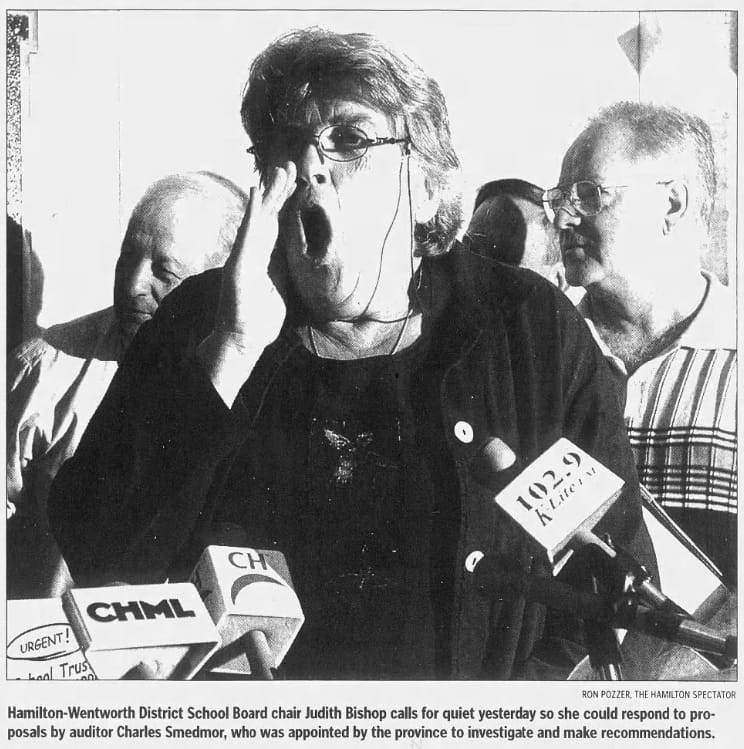
The community sided with the trustees. For her tireless advocacy, Bishop earned a glowing profile in the Spec, praise from then-MPP David Christopherson, and overwhelmingly positive words of encouragement in letters to the editor.
But the province wasn’t backing down. Witmer gave the HWDSB’s trustees one week to pass a balanced budget. In a six-to-four vote, the trustees decided to not reconsider their original budget, with trustee Reg Woodworth dramatically saying “[The province] created the crisis and now let them live with the crisis.” The very next day, Hamilton’s public trustees were all-but dismissed and the province’s appointed supervisor, Jim Murray, was given extraordinary powers to close schools, cut programs, and balance the books by any means necessary.
In the ultimate insult, Murray’s first act was to remove Bishop from her trustee office and claim it as his own.31
***
Her powers stripped, Bishop continued to serve as an advocate for Hamilton’s youth. She pleaded with the province’s review panel established to update the school funding formula to make necessary changes so school boards could fund public education. She challenged Murray when he cut the supply teacher budget. When Murray’s new budget was adopted but the province refused to relinquish control to local elected officials, Bishop and her fellow trustees publicly called for their powers to be restored. In December of that year, Bishop penned another lengthy column in the Spec outlining the impact of school closures and stating that, even though their powers had been removed, “trustees continue to hold a moral responsibility to be the watchdog for Hamilton-Wentworth’s public education.”32
Even sidelined, Bishop’s focus was on maintaining the public trust.
It was only after Dalton McGuinty’s Liberals formed government in late October of 2003 that provincial supervision of the HWDSB came to an end. With only weeks to go before the municipal elections, a “transitional management team” assumed responsibility for the board until new trustees could be sworn in on December 1, 2003. Bishop, having been acclaimed to office, was appointed to the “co-management” team intended to ease the community back into democratic control over schools. At a public meeting to discuss the restoration of local power, trustees were berated by community members who blamed amalgamation, partisan interests, shortsightedness, overspending, and politicians in general for all the board’s ills. In the wake of the supervision and public backlash, Bishop opted to not seek another term as chair, handing the reigns of power back over to long-time Ward 4 trustee Ray Mulholland.33
After 2003, Bishop returned to her work of front-line advocacy. She worked on summits to improve public engagement with the board, wrote extensively on the need to tackle childhood poverty, and continued to advocate for improved education funding.34 Before the 2006 election - in which she was once again unopposed - Bishop mused that the board’s composition might be reflective of the kinds of people who can afford to do the full-time-work-for-part-time-pay of trustees: “The only people at the moment who can put in a lot of time are those who’ve got husbands in secure jobs who don’t mind subsidizing their wives, or they’re retired, and that’s not very healthy for an organization dealing with young people.”35
Another tenure as board chair followed from 2006 to 2009, albeit one that was far less controversial than her previous stint at the helm. There were some minor sparks when the HWDSB’s trustees signed onto a call for one unified school system, leading Bishop’s Catholic counterpart, Pat Daly, to say Hamilton’s separate school trustees were “extremely disappointed” by the HWDSB’s “very hurtful” actions.
Speaking with the Spec in 2007 about the pressures of the job (30 to 40 emails a day, 12 hours of work, missed time with family), Bishop said that politics wasn’t appealing to many women because of how society has forced standards on them: “In the past we’ve been socialized that a good woman was one who didn’t make too much of a spectacle of herself…in a way, that’s what you’re doing when you get into this sort get into this sort of arena.”36
She finally had enough. In stepping down as chair, Bishop said she wanted to avoid creating a dynasty and preventing succession planning. “It’s important that you don’t stay too long,” she told the Spec.37 While some speculated she would not seek re-election in 2010, she did, and was acclaimed for the third and final time.
After her retirement from politics in 2014, Bishop remained active in the community. She wrote extensively, carried on with her advocacy, and was known to play a mean game of badminton. In November of this year, Bishop penned an op-ed in the Spec about how the current government’s Bill 33 - which may see trustees abolished entirely in Ontario - “reverses an Ontarian tradition of local involvement in education policy,” and that “Bill 33 must be stopped and public education needs to be properly funded.”38
Five days after the publication of that piece, Bishop passed away suddenly at age 83.
***
In everything she did, Judith Bishop’s focus was always on social justice and the welfare of children. Her passion for this community and for local schools was so incredibly evident in all her work and the years of service she gave to Hamilton. Right up until the end, she continued to advocate for the things in which she believed with such passion.
Hamilton is a better community for having had Bishop’s voice at the table.
In her piece from 1996, Bishop hoped that, by next year, Hamilton would be a place where “children go to vibrant schools in safe neighbourhoods, where the community strongly supports the education they are receiving.”
With the way the Ford government is eying education, it’s hard to say if that dream will be fully realized. But, by her work, she did all she could in pursuit of that goal. And that’s a legacy worth remembering.
1 Andrea Horwath. “A year of momentum, progress and opportunity” Hamilton Spectator, December 27, 2025 (Spec link - Paywalled).
2 Judith Bishop. “How Hamilton’s students could become Ontario’s best” Hamilton Spectator, February 15, 1996 (Spec archive link - Paywalled).
3 Spec Sources (all archived and paywalled): January 14, 1997 (Link); March 5, 1998 (Link); March 21, 1998 (Link); March 24, 1998 (Link).
4 “Crumbling schools get $2.1b lifeline” Hamilton Spectator, May 26, 2004 (Spec archive link - Paywalled).
5 Lee Prokaska. “Hamilton native will run board” Hamilton Spectator, August 31, 2002 (Spec archive link - Paywalled).
6 Carmelina Prete. “School-closing review committees to be struck” Hamilton Spectator, February 11, 2010 (Spec archive link - Paywalled); Teri Pecoskie. “School’s out…forever?” Hamilton Spectator, May 5, 2012 (Spec archive link - Paywalled).
7 Eleanor Tait. “Trustees order Binkley closing” Hamilton Spectator, May 11, 1979 (Spec archive link - Paywalled); Doreen Pitkeathly. “The last day of school’s sad for Princess Elizabeth” Hamilton Spectator, June 29, 1983 (Spec archive link - Paywalled).
8 Spec sources: April 29, 2011 (Link); November 30, 2011 (Link); January 12, 2012 (Link); March 7, 2012 (Link).
9 Teri Pecoskie. “Fight over Prince Philip down to final battle” Hamilton Spectator, March 21, 2012 (Spec archive link - Paywalled).
10 “Judith Bishop not running this fall, ending 26-year tenure as school board trustee” Hamilton Spectator, July 17, 2014 (Spec archive link - Paywalled).
11 “Oxfam plans film night” Hamilton Spectator, October 30, 1971 (Spec archive link - Paywalled); Luma Muhtadie. “Balancing passion and principle” Hamilton Spectator, August 22, 2002 (Spec archive link - Paywalled).
12 Spec Sources: January 17, 1974 (Link); April 2, 1974 (Link); October 11, 1975 (Link); November 21, 1978 (Link).
13 Mary K. Nolan. “School problems tied to enrolment” Hamilton Spectator, November 8, 1980 (Spec archive link - Paywalled).
14 John Fox. “Teachers’ strike looms April 22” Hamilton Spectator, April 13, 1985 (Spec archive link - Paywalled); Christine Cox. “Striking teachers await board reply” Hamilton Spectator, April 27, 1985 (Spec archive link - Paywalled).
15 “Ad - Board of Education” Hamilton Spectator, May 7, 1985 (Spec archive link - Paywalled).
16 Carol Corley. “Board as incenses teachers” Hamilton Spectator, May 7, 1985 (Spec archive link - Paywalled); John Fox. “High school teachers on strike” Hamilton Spectator, May 11, 1985 (Spec archive link - Paywalled).
17 Christine Cox. “Other schools won’t take city students” Hamilton Spectator, August 3, 1985 (Spec archive link - Paywalled); “Teachers’ return puts paid to other plans” Hamilton Spectator, August 22, 1985 (Spec archive link - Paywalled).
18 “Social worker seeks school board seat” Hamilton Spectator, October 21, 1985 (Spec archive link - Paywalled); Christine Cox. “Memory of teachers’ strike clouds trustee vote” Hamilton Spectator, November 5, 1985 (Spec archive link - Paywalled); "" “Newcomer fills vacant education spot” Hamilton Spectator, November 13, 1985 (Spec archive link - Paywalled).
19 Christine Cox. “Bari wants to attend school with his friends” Hamilton Spectator, October 31, 1986 (Spec archive link - Paywalled); “The Magnificent 7: Hamilton area women honoured” Hamilton Spectator, October 31, 1986 (Spec archive link - Paywalled); “‘Ghettos of special education’ drawn to trustees’ attention” Hamilton Spectator, April 1, 1987 (Spec archive link - Paywalled).
20 “Second bid by Bishop” Hamilton Spectator, October 6, 1988 (Spec archive link - Paywalled); Christine Cox. “Six new faces as strong turnout at the polls” Hamilton Spectator, November 15, 1988 (Spec archive link - Paywalled); “Trustee Hicks spent most in school board elections” Hamilton Spectator, August 18, 1989 (Spec archive link - Paywalled).
21 Spec Sources: January 20, 1989 (Link); September 13, 1989 (Link); February 17, 1990 (Link); March 2, 1990 (Link); July 13, 1990 (Link); June 21, 1991 (Link).
22 Spec Sources: May 9, 1992 (Link); June 10, 1993 (Link); June 18, 1993 (Link); October 1, 1993 (Link); May 2, 1994 (Link).
23 Christine Cox. “New trustee follows lead of father, grandfather” Hamilton Spectator, November 15, 1994 (Spec archive link - Paywalled).
24 Spec Sources: December 2, 1994 (Link); December 27, 1995 (Link); April 15, 1996 (Link); June 28, 1996 (Link).
25 Steve Arnold. “Education at risk: group” Hamilton Spectator, March 10, 1997 (Spec archive link - Paywalled); Suzanne Morrison. “Trustees overboard” Hamilton Spectator, October 18, 1997 (Spec archive link - Paywalled).
26 Mark McNeil. “Heart problems” Hamilton Spectator, October 31, 1997 (Spec archive link - Paywalled); “Election results” Hamilton Spectator, November 12, 1997 (Spec archive link - Paywalled).
27 “Province is rushing school closings” Hamilton Spectator, October 23, 1998 (Spec archive link - Paywalled); “United approach to closing schools” Hamilton Spectator, November 3, 1998 (Spec archive link - Paywalled).
28 Spec Sources: April 7, 2000 (Link); June 1, 2000 (Link); October 27, 2000 (Link); November 10, 2000 (Link); November 14, 2000 (Link).
29 Peter Van Harten. “Ecker wants funding review” Hamilton Spectator, March 8, 2002 (Spec archive link - Paywalled).
30 Spec Sources: July 15, 2002 (Link); July 18, 2002 (Link); August 10, 2002 (Link); August 13, 2002 (Link).
31 Spec Sources: August 19, 2002 (Link); August 20, 2002 (Link); August 21, 2002 (Link); August 22, 2002 (Link); August 23, 2002 (Link); August 23, 2002 (Link); August 26, 2002 (Link); August 27, 2002 (Link); August 27, 2002 (Link); August 29, 2002 (Link); September 6, 2002 (Link).
32 Spec Sources: September 24, 2002 (Link); October 22, 2002 (Link); November 21, 2002 (Link); December 5, 2002 (Link).
33 Spec Sources: November 1, 2003 (Link); November 5, 2003 (Link); November 26, 2003 (Link); December 2, 2003 (Link).
34 Spec Sources: April 30, 2005 (Link); December 12, 2005 (Link); October 20, 2006 (Link).
35 Rob Faulkner. “Trustee’s job more diverse than in ‘60s” Hamilton Spectator, September 19, 2006 (Spec archive link - Paywalled).
36 Dana Brown. “A campaign to put more women on the ballot” Hamilton Spectator, May 26, 2007 (Spec archive link - Paywalled).
37 “Bishop bows out” Hamilton Spectator, November 20, 2008 (Spec archive link - Paywalled).
38 Judith Bishop. “Bill 33 is too much control” Hamilton Spectator, May 26, 2007 (Spec link).